
Before flying to Luang Prabang, we had an afternoon to wander around Vientiane,  the capital of Laos. Vientiane is just across the Mekong river from Thailand and it actually is pronounced “Wieng Chan”. You’ll have to ask someone who speaks French explain the spelling. Vientiane is the home of Pha That Luang; a stupa that is Laos’ national monument. The grounds surrounding Pha That Luang include two temples and beautifully landscaped parks. We had arrived in the late afternoon and as we walked around we
  were accompanied many Laotians also enjoying the parks. The stupa itself was closed for the day so we didn’t see any other tourists. A large truck was spraying water out over the gardens and children were playing in the spray. In the empty parking lot, there were some older boys and men were playing soccer. The whole scene was reminiscent of a summer evening in “Small Town U.S.A.”
On the way back to our hotel we passed an interesting monument called Patuxai. It was inspired by the French Arch of Triumph but built with US purchased cement in the 1960s. The cement was supposed to be used to build an airport and this bit of history has earned the monument the nickname “the vertical runway”. It is surrounded by a nice park that seemed to be quite popular.
The morning of March 13 we arrived at the small airport  (perhaps they didn’t have enough cement for a larger one) two hours early for our one hour flight. As much as we dislike waiting in airports, it was better than an 11 hour bus ride to Luang Prabang. The wait did give me an opportunity to read the guide book and learn that my expectations for Luang Prabang were off. The city is a UNESCO World Heritage site just like Angkor Wat only the temples in Luang Prabang are not as old. Many of the temple sites date back 500 years but only two temples survived various attacks from neighboring countries. The people of Luang Prabang must be very
  determined people because they just built the temples again and so the city has retained the “urban plan” it has had for 500 years. This is what has earned it UNESCO World Heritage status.
Upon arriving in Luang Prabang, we learned from our driver that Laos’ official name is Laos People’s Democratic Republic and its nickname is Laos Please Don’t Rush. Apparently, Laotians are very laid back and often late. Karl had made arrangements to take pictures of a young lady in traditional Laotian costume the following afternoon,  so Tuesday evening and most of the day Wednesday we went around town looking at temples. Karl’s objective was to find a good location with a nice backdrop to take the pictures. I reluctantly became the stand-in as Karl tried out different locations and worked out his compositions. This can take a bit of time and in many of the pictures I’m quite distracted, even reading our guidebook instead of looking at the camera. Here is one where I actually was paying attention, the rest are not all that flattering so you won’t see any of those here!
Luang Prabang isn’t a very large city so we were able to get around to most of the temples on bicycles. Some of the temples were right next door to each other and we walked from the courtyard of one temple into the courtyard of another. The temples are beautifully gilded; sometimes covering the entire front of the temple. Usually, there is a stupa or two somewhere on the grounds and occasionally they are painted gold. The offerings made with banana leaves and marigolds even resemble gilded stupas. At Luang Prabang’s oldest temple, Xieng Thong, we admired the  complex mosaics that cover the temple and a couple of small chapels on the temple grounds. The mosaic on the back wall of the temple is a huge tree of life flanked with peacocks. The mosaics on the small chapels are simple village scenes that seem to tell stories. The reflective tiles are expertly cut and placed to create people, palm trees, elephants and more.
Luang Prabang is built on a peninsula shaped similarly to Florida at the intersection of the Mekong and Nam Khan rivers. So, as we cycled to the various temples we often caught sight of one of the rivers.  The ever-present haze from burning rice fields muted the beauty of the rivers and the lush vegetable gardens on their banks. Besides interfering with Karl’s opportunities for landscape photography the smoke has also been very irritating to our eyes and throats. After scouting locations we learned that the young lady, Min, couldn’t come Wednesday afternoon and would meet us the next morning. She did come the next morning but an hour later than planned and she didn’t have much time before she had to go to class. She agreed to come back between her classes around lunch time. We didn’t mind the delays; we know that is just how things are done. It’s best just to go with the flow and enjoy the journey!
In the mean time, we went to a nearby village that does hand weaving of cotton and silk.  We got a demonstration from a lady who was weaving a scarf. It was interesting to see how the pattern of the scarf was created by the way that the threads were arranged on the loom. Nearby another lady wound thread onto spools. The device that she used employed an old bicycle wheel to spin the spool fast enough to get the proper tension. We returned to Luang Prabang, met up with Min and went to two temples that we had picked out the previous day. Our favorite was Wat Chum Khong because the grounds were beautifully landscaped and there were lots of flowers. At Wat Chum Khong a little boy followed us around, sneaking into little hiding places where he could watch these strange foreigners.
Every evening, there is an incredible handicraft market that closes down the main road of Luang Prabang for about a quarter of a mile.  Vendors setup on either side of the road and down the middle with bare light bulbs hanging over their little square of the market. I particularly liked how the paper lanterns looked. The market was very atmospheric with many colorful textiles and souvenirs to look at. As we walked around we were greeted with smiling faces and soft voices speaking the little English they knew. Overlooking it all was Phu Si temple from the top of the hill by the same name. We would go every evening and Karl would look for photo opportunities. Just like in Wangpikun, Karl likes to take pictures of people and so we ended up buying quite a few things to get permission!
  In Laos they use kip and 10,000 kip is approximately equal to one dollar. At first you might think that is a great exchange rate and you are going to make out like a bandit. Then you see the prices of every thing. The prices of most things are given in five digits and the only price that is given with less than 4 digits is the per-minute charge at the internet cafes. We were told by our friends in Thailand that we would need a big purse. That is because the biggest bill that you can get in Laos is 50,000 kip but they mostly use 20,000 kip bills. So, right after a visit to the bank to exchange money we felt like we had a big wad of cash. Our wad never seemed to last as long as we thought it would. When you have 700,000 kip you think it will last a while!
Thursday, March 15, 2007
Laos, Please Don't Rush

Monday, March 12, 2007
Country Hopping
Tuesday morning we were back in Angkor Thom. This time we’d come to see some of the other temples and structures in the walled city.  Angkor Thom also has a moat and the bridges over the moat have decorative balustrades on either side. Each balustrade is the body of a Naga, a mythical 7 headed snake, which is common through out the temples. The bridges are a bit different because they have sculptures of large men holding the body of the Naga. There is a huge man with many arms holding the head of the Naga at the entrance to the bridge. Over the years, most of the men have lost their heads and a few have lost more than that. The bridge to the south gate is the most complete and many of the heads have been replaced. This picture shows the original head of one of these men and the gate to Angkor Thom in the background.
Once inside Angkor Thom we stopped at the Terrace of the Elephants,  which faces the main road of Angkor Thom. In the middle of this long terrace is a wide viewing stand where the king would sit to watch military processions. The walls of the terrace mirrored what the king would have seen with carvings of soldiers, chariots and elephants. The carvings are almost life-size so as you approach the terrace it is the images of elephants that stand out.
Our next stop was an out of the way temple called Preah Palilay.  It was back behind most of the Angkor Thom attractions and to get to it we had to walk through what looked like the ruins of expansive ancient patios. We passed a group of wooden homes that housed some of the vendors who worked in Angkor Thom and finally arrived at Preah Palilay. This temple definitely looked like it had seen better days. Only about half of what had been a vaulted sanctuary still stood and it now shared space with several large trees which had taken root in the temple base. This temple had a nice atmosphere as there were few tourists and the trees provided some relief from the sun. We even found another lion that still had its face.
Before heading back to our hotel to escape the heat of the day, we stopped at Preah Khan which is outside of Angkor Thom to the north.  We were lured to this temple by a picture in our guidebook of a grand building with cylindrical columns. It looked more like it would belong in Rome than in Cambodia. When we first entered the temple area, we crossed a bridge over a nearly dry moat and were delighted by dozens of dragonflies lazily drifting a few feet above the ground. The trip to this temple went downhill from there. We were hot and tired and once inside the inner wall we didn’t see this grand structure that we came for. After consulting our guidebook, we found that it was a smaller building on the far side of the temple grounds. We headed through the temple and there were no worries about getting lost in this temple because there were very few passages which were actually passable. For the fun of it, I took a picture of one of the many signs warning tourists. When we made it to the building we were disappointed. It didn’t look as grand as it did in the picture. On our way back through the temple we grumbled about photographers and their wide-angle lenses. Never mind that Karl is one of them.
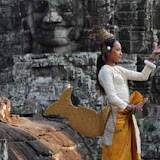
Tuesday evening, we ventured out for another evening at Bayon. It has turned out to be Karl’s favorite place for photo opportunities. If he isn’t taking pictures of the well-known stone faces, he’s taking pictures of the Cambodian dancers. This evening, there were two girls dressed in the “fish” costumes. This picture is the one that Karl says is the best and it is the last one he took before we left for the day. We've added more pictures of the dancers and temples to our Cambodia photo album here Cambodia
There are a lot of very poor people in Cambodia and a tourist attraction like Angkor Wat also attracts the poor who hope to make a better life for themselves.  They usually don’t have any skills so start by selling trinkets to the tourists. Their children would either join them in selling or play nearby. Each time we visited a site there would be several people (including children) trying to sell us an assortment of things. The children have also learned that letting foreigners take pictures of you is another way to earn a little money. We didn’t mind giving these girls a little money, but it was a stark reminder that there are a lot of children in this world who struggle just to survive.
Since our return from Cambodia, we did some searching on the internet to find some charities that operate in Siem Reap. To our surprise there are a few that you can support while in Siem Reap by volunteering your time and they don’t need a lot of advance notice. Now, I wish I’d done the search before we went. If you ever consider traveling to Siem Reap, take a look at www.ivebeenthere.co.uk/places/cambodia/siem-reap/tips/charity for some ideas on things that you can do while you are there. For those who want to help from afar or for someone who foolishly didn’t do her homework before visiting Cambodia the following are some charities that help children in Siem Reap and Poi Pet:
Schools for Children of Cambodia
KANTHA BOPHA Children's Hospital
Friends Without a Border Wednesday, we made the journey from Siem Reap to Poi Pet at the Cambodia/Thailand border. Before we left, we said goodbye to the staff at the Apsara Palace Hotel. It’s a small hotel and they were very nice and helpful. The trip back was another long, bumpy, dusty ride. The picture below shows one stretch of the highway between Siem Reap and Poi Pet. I had mentioned the creative contraptions designed for motorcycles. The baskets you see on the back of the motorcycles hold either 5 too 6 piglets or one large pig. Can you imagine trying to maintain your balance with that on the back of your motorcycle!?
We returned to Nang Rong for a few days while my travel agent (Karl) made reservations for a trip into Laos. He’s been an excellent travel agent! We also took the time to take care of a few things but mostly we rested and relaxed. Karl got to ride around on a motorcycle and take pictures and I got to play with Wick’s website a bit more. He now has a domain name: nangronghomestay.com.
Sunday, we took a bus to Nong Khai on the Thailand/Laos border and today we crossed over the border into Laos. So, now we can say that we visited three countries in a week! Tomorrow, we will be flying to Luang Prabang where there are more ancient temples for us to see.