
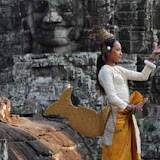
We have had an enjoyable week in Nang Rong before heading to the border and into Cambodia. We had to get our visa renewed after two months in Thailand and to do that we had to leave the country and come back in. So, we are in Cambodia for a few days of sightseeing before we return to Nang Rong. While in Nang Rong we took advantage of its close proximity to many major temple ruins and Sunday afternoon we went to see them. Most of the ancient temples in this area are about 1000 years old and they are Hindu temples with many carvings depicting stories from Hindu legends. The picture below shows a carving of Dancing Shiva a Hindu god.
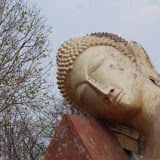
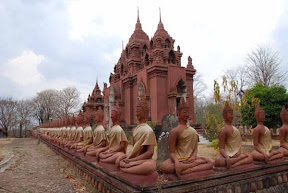 Our first stop on Sunday was actually to a Buddhist temple that is about 50 years old called Mount Angkharn Temple. Although it isn’t an ancient temple, it is unique in many ways. It has a huge reclining Buddha which is approximately as long as a football field and the style of the temple itself is different from the other temples that we’ve seen. You can see for yourself in the picture that all the tiny reflective tiles are absent from this temple. Despite the absence of the glittering façade, the temple and its surroundings are very beautiful. It is perched on top of an extinct volcano and overlooks one area where warm water still bubbles to the surface. Most Buddhist temples have large murals on the inside of the temple and under each mural is a description of the picture in Thai. At Mount Angkharn Temple, the descriptions are in English! It is surprising that such an out of the way temple would have descriptions in English. It is so out of the way that they only recently got a paved road up to the temple.
 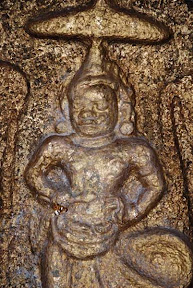 The most fascinating thing about this temple is that when they were building it, they discovered some artifacts which suggest that there was a Buddhist temple on the very site more than 1000 years ago. It was explained to us that until these artifacts were unearthed historians believed that the people in this area were strictly Hindu. The picture shows one of these ancient carvings which is in very good condition. What is unfortunate is that on many of the carvings, the face has been removed. At all of the ancient temple sites, people have stolen pieces or the whole artifact to sale them on the black market. Wic told us that during the Vietnam War many things just disappeared. He shared one story about a huge sandstone elephant that had been in a small village for centuries. One day they came back from the rice fields and it was gone!
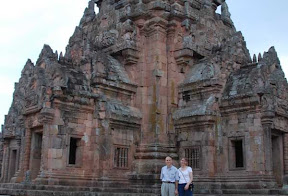
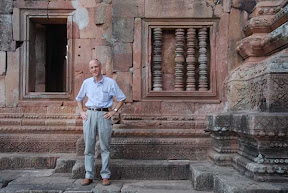 Prasat Phanom Rung was our next stop and this temple is quite large and well known. There were a few other foreign tourists there but there were also a lot of Thai tourists. To our surprise, we became tourist attractions ourselves. A couple of Thai tourists approached us and asked to have their picture taken with us. Of course we agreed, after all the pictures we’ve already taken with Thai people it is only fitting to have the tables turned on us! Prasat Phanom Rung is an impressive structure. It also sits on top of an extinct volcano and has a grand walkway up to the entrance of the temple. We came to this temple when we were in Thailand three years ago and we are using the picture we took at this temple in the “About Me” section of our blog. Below is an updated picture from the same spot. Prasat Phanom Rung looks the same but I’m not sure I can say the same for those two tourists!
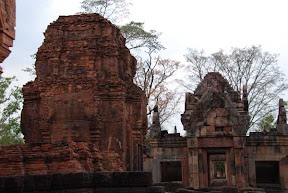 Before heading back, we stopped at a smaller temple called Prasat Muang Tam. We also had visited this temple on our previous trip and Karl got some beautiful pictures here. This temple has four “L” shaped ponds within its courtyard and it creates a very nice atmosphere. We were at this temple when the sun was setting and Karl tried to capture how beautiful the scene was as a fiery red sun flickered in and out of the ancient windows. It seems however that a camera lens can’t capture everything exactly as it looks when you are seeing it for yourself.
 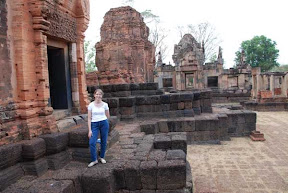 I guess the solution is for everyone who would like to see the sunset at Prasat Muang Tam to start planning your trip!
There were so many beautiful and interesting pictures that Karl took at these temples that there just wasn’t room to put them all here. So, we have put the best pictures that Karl took on our online photo album at: Nang Rong There are more pictures of these temples and others on the website for the place where we are staying: P. California Inter Hostel
Monday we went to visit the local community college and talk with the director that we had dinner with the previous Friday.
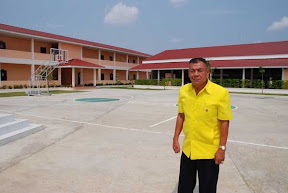 After some discussion, we learned that the director is hoping to get anyone interested in teaching English to come. He is interested in someone to teach conversational English so a teaching certificate is not required. The school would take care of all living expenses and possibly provide a little spending money. It’s kind of a mix between a volunteer opportunity and a job. We thought it would be a great way for a college student to get a free vacation to Thailand! So, if you know of any college student up for an adventure, send them our way!
In the afternoon, we went to the school in the village where we taught English last Friday.
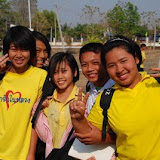
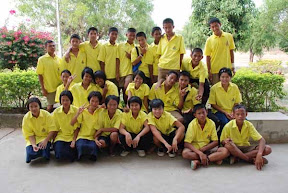 The name of the school is Baan Nong Chae Mai and we were invited back to teach again. We taught two classes and had a lot of fun with the students. The lesson that we used was to go over phrases the kids would need to know to introduce themselves in English. We encourage them to talk about things they like; such as their favorite sport, food, music, etc. It’s a good way to get the students talking. Here’s a picture that we took of one of the classes after school.
On Tuesday and Wednesday, Karl rented a motorcycle from Wick and went driving around in the villages outside Nang Rong.
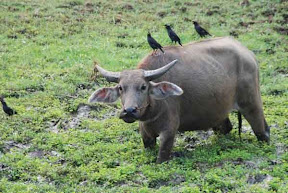 He often stopped and talked to the local people trying to get to know them better. Karl stopped to talk to one lady who was herding water buffalo. Karl wanted a picture of the water buffalo but they kept walking away from him. The lady told Karl that the water buffalo were afraid of foreigners and sure enough one of those water buffalo kept staring right at Karl.
Nang Rong is a bigger town than Wangpikun and after a short ride on the motorcycle in Nang Rong traffic, I opted out of additional motorcycle rides. Instead I felt much more comfortable at Wick’s place reading a book, responding to email or helping Wic do some quick updates to his website. I know the last bit sounds like work, but those people who work with me know how much I like to get my hands into programming. Anyway, I was happy to help Wick because he is always so helpful to us when we stay at his place. As I mentioned previously, he also helps support volunteers who come to Nang Rong to teach English. The website to volunteer in Nang Rong is: Thailand-volunteering Centre It is in German because the program is administered by a German, but you can translate the page to English at: http://babelfish.altavista.com/.
Wednesday, we went to the Cambodian border and crossed at Poi Pet.
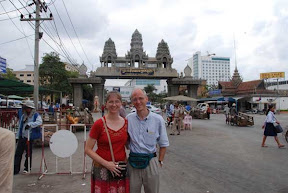 I knew that Cambodia was a much poorer country, but it was still a bit of a surprise to see the difference from one side of the border to another. On the Thai side of the border the streets were paved, the cars newer and the people better dressed. On the Cambodian side, roads that were paved had large holes in the pavement, many of the cars were older and in general the people were dressed in worn clothing, some children were just in rags. The drive from Poi Pet to Siem Reap was about 150 kilometers and took over 3 hours. Almost the entire way was dirt road and even when there was pavement it was full of holes. It was quite bumpy and the driver continued to drive about 50 miles an hour. It was quite an experience!
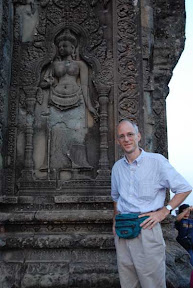 After arriving in Siem Reap, we made arrangements to view the sunset from Phnom Bakheng. It is a hilltop temple from which Angkor Wat can easily be seen. It is quite a popular place for people to view the sunset and by the time we arrived at the base of the hill it was already crowded with tour buses and tuk-tuks. We followed a path that wound around and up the hill. As we walked, we passed the ancient staircases that had been built on four sides of the hill for the worshipers of old to ascend. They were no longer in usable condition but they were still distinguishable as stairs. The temples of this area are built with several terraces and this temple was swarming with tourists on the top terrace.
 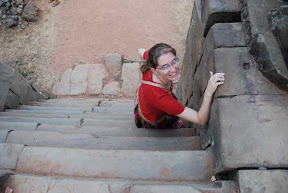 The stairs on the temples are quite steep as each step is twice as tall and half as wide as a normal step. We overheard from one of the many tour guides that the steps were built that way to slow a worshiper’s ascent and provide more time for contemplation as they climbed up. After centuries of wear and tear, the steps were even more treacherous and we slowly climbed while we contemplated the broken bones we would sustain if we fell! We made it to the top safely and Karl was able to get some pictures of Angkor Wat as the sun went down. The other two pictures are of Karl standing next to a carving of a Apsara dancer and me on the stairs.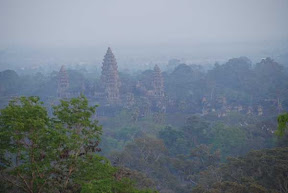

No comments:
Post a Comment